
About the Company

A Primer on the Basic Principles of Inertial Sensors

新产品

A Primer on the Basic Principles of Inertial Sensors

June 01, 2026

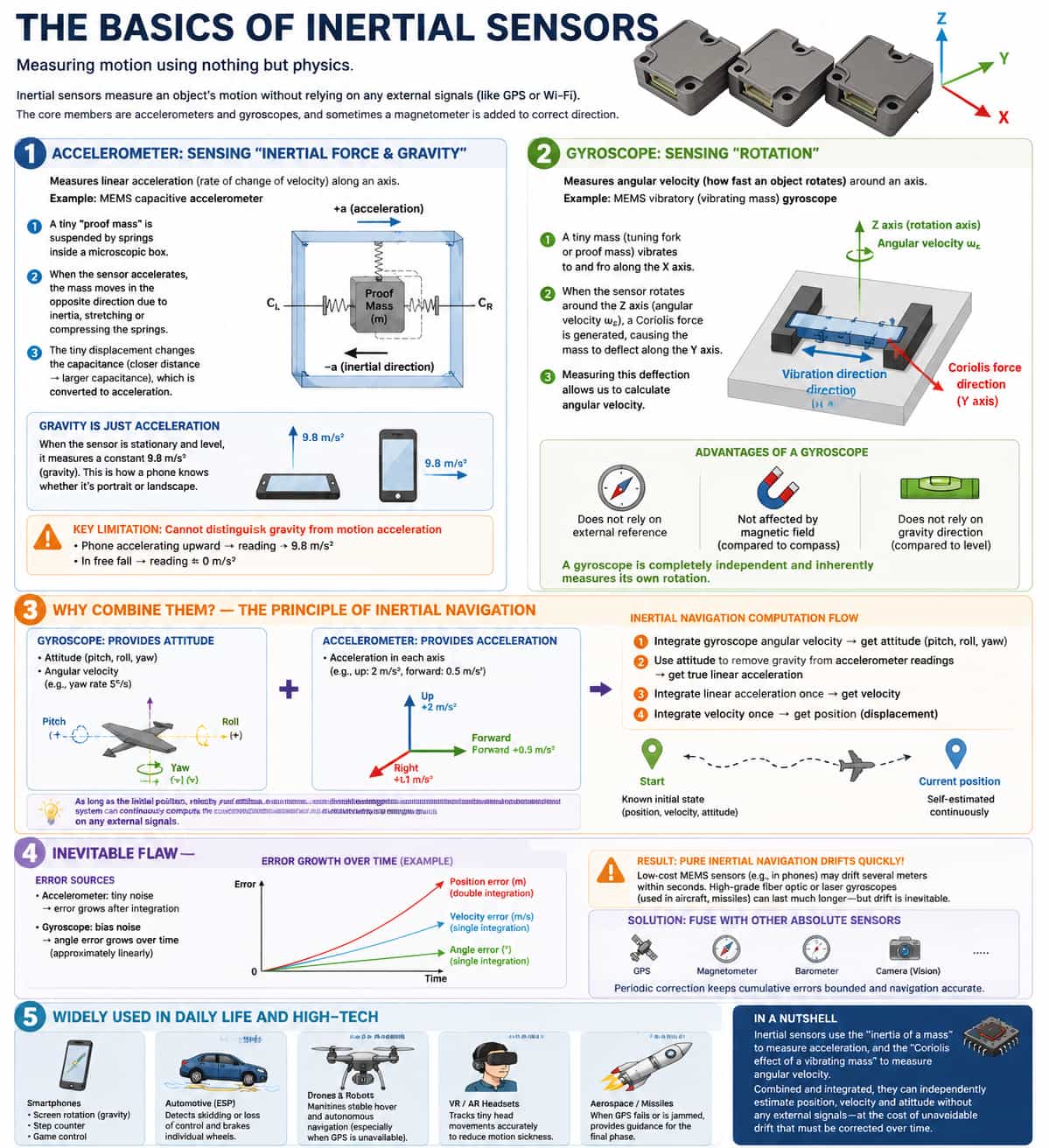
MEMS IMUAn inertial sensor is a device capable of measuring an object's motion state in space solely by relying on intrinsic physical laws, without depending on any external signals (such as GPS or Wi-Fi). Its core components are accelerometers and gyroscopes; these devices frequently work in tandem, sometimes supplemented by a magnetometer to assist in orientation correction.

1. Accelerometer: Sensing "Inertial Force and Gravity"

An accelerometer measures an object's linear acceleration in a specific direction—that is, the rate at which its velocity changes. Taking the most common type—the MEMS capacitive accelerometer—as an example: imagine a tiny "proof mass" suspended by springs inside a miniature housing. When the entire sensor accelerates, the proof mass shifts in the opposite direction due to inertia, causing the springs to stretch or compress. This minute displacement is then converted into a change in capacitance (where closer proximity results in higher capacitance), thereby allowing the acceleration to be calculated. According to the General Theory of Relativity, gravity is equivalent to acceleration; therefore, when the sensor is stationary and lying flat, it registers a constant reading of 9.8 m/s² (the acceleration due to gravity). This is precisely how a smartphone determines whether it is in "landscape" or "portrait" mode—by sensing the direction of gravity. However, accelerometers possess a critical limitation: they cannot distinguish between gravity and acceleration caused by motion. For instance, if a smartphone accelerates vertically upward, its reading will exceed 9.8 m/s²; conversely, during free fall, the reading will approach zero.

2. Gyroscope: Sensing "Rotation"

A gyroscope measures an object's angular velocity—the speed at which it rotates—around a specific axis. Using the MEMS vibratory gyroscope as an example, this device harnesses the physical phenomenon known as the Coriolis effect: imagine a tiny tuning fork or proof mass being driven to oscillate rapidly back and forth. When the sensor as a whole rotates, this oscillating mass is subjected to a force—the Coriolis force—that acts perpendicular to both the direction of oscillation and the axis of rotation. This force causes the mass to undergo a minute lateral displacement; by measuring the magnitude of this displacement, the angular velocity of the rotation can be calculated. The value of the gyroscope lies in its independence from external references; it is inherently capable of measuring its own rotation. This capability renders it more powerful than devices such as compasses or spirit levels: while a compass is susceptible to interference from magnetic fields and a spirit level requires the reference of gravity, a gyroscope operates in complete autonomy.

3. Why is a Combination of Both Necessary? — Principles of Inertial Navigation

Using accelerometers or gyroscopes in isolation presents inherent challenges; however, by combining both with data fusion algorithms, inertial navigation can be achieved. The gyroscope provides information regarding current attitude and rotational velocity (e.g., "oriented 30° east of North, rotating at 5° per second"), while the accelerometer reports acceleration along various axes (e.g., "upward acceleration is 2 m/s², forward acceleration is 0.5 m/s²"). However, to subtract the gravitational component from these readings, the current attitude—provided by the gyroscope—must be known. The specific calculation process unfolds as follows: integrating the gyroscope's angular velocity yields the attitude (pitch, roll, and yaw angles); using this attitude information, the gravitational component is subtracted from the accelerometer readings to derive the true acceleration of motion; integrating this motion acceleration once yields velocity, and integrating the velocity once more yields displacement (change in position). Consequently, provided that the initial position, velocity, and attitude are known, an inertial navigation system can continuously calculate and output the current position and orientation throughout any movement, operating entirely independently of external signals.

4. An Inherent Flaw That Must Be Addressed—Drift

Inertial sensors suffer from an unavoidable drawback: cumulative integration error—commonly referred to as "drift." Accelerometers exhibit minute levels of noise; when integrated to derive velocity, this error is amplified once, and when integrated again to derive displacement, the error escalates dramatically. Simultaneously, gyroscopes also introduce minute errors in their angular velocity measurements; when integrated to derive angular position, this error grows linearly over time. The result is that a purely inertial navigation system will develop significant deviations within a span ranging from a few seconds to a few minutes. While expensive fiber-optic or laser gyroscopes (typically used in aircraft and missiles) can maintain accuracy for longer periods, the inexpensive MEMS sensors found in mobile phones may drift by several meters within just a few seconds. Therefore, it is essential to periodically correct the cumulative errors of inertial sensors by utilizing other absolute measurement sensors—such as GPS receivers, magnetometers, barometers, or vision cameras. 5. Ubiquitous Applications in Daily Life

Inertial sensors are widely applied in both everyday life and high-tech fields: in mobile phones, they enable screen rotation (accelerometers sense gravity), step counting (accelerometers detect the vibrations of walking), and directional control in games (gyroscopes); in automotive Electronic Stability Programs (ESP), they detect whether a vehicle is fishtailing or skidding, allowing for the instantaneous braking of individual wheels; in drones and robots, they maintain stable hovering and facilitate autonomous navigation (particularly when GPS signals are lost); in VR/AR headsets, they precisely track minute head movements to minimize motion sickness; and in aerospace and missile systems, they serve as the primary guidance mechanism during the final stages of flight, or whenever GPS signals fail or are subject to interference.

In summary, inertial sensors measure acceleration by leveraging the "inertia of a proof mass" and measure angular velocity by utilizing the "Coriolis effect on a vibrating mass." By combining these measurements and performing integration calculations, they can autonomously determine an object's position, velocity, and attitude without relying on any external signals—though this capability comes with the inherent trade-off of accumulating drift errors over time.

Subscibe To Newsletter
请继续阅读,关注我们,订阅我们的内容,也欢迎您告诉我们您的想法。

留言

留言
如果您对我们的产品感兴趣并想了解更多详情,请在此留言,我们会尽快回复您。
提交

产品

WhatsApp

联系我们