
About the Company

An Analysis of the Practical Impact of Bias, Thermal Drift, and Noise in Inertial Sensors on Project Applications

新产品

An Analysis of the Practical Impact of Bias, Thermal Drift, and Noise in Inertial Sensors on Project Applications

June 09, 2026

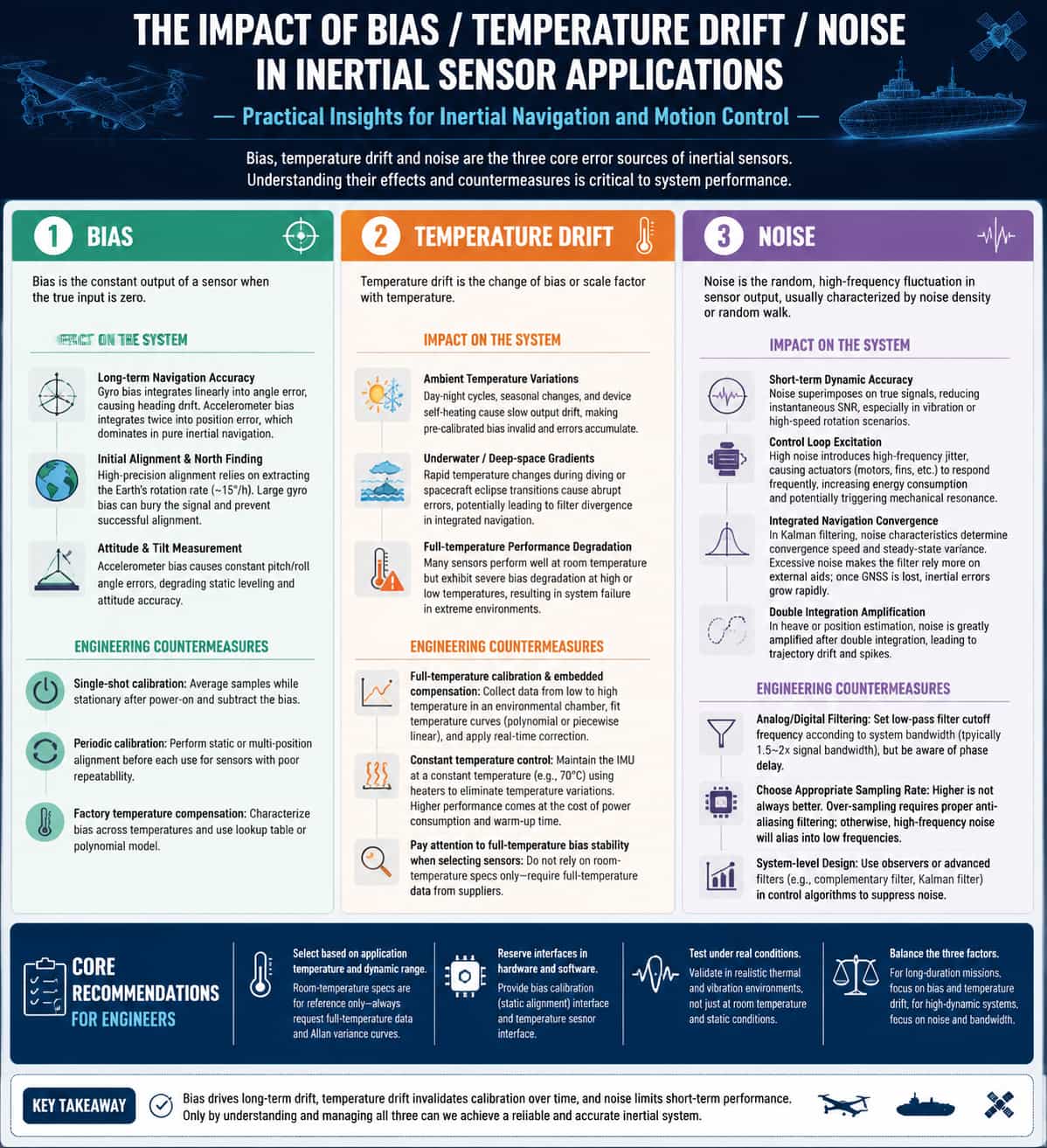
MEMS IMUIn inertial navigation and motion control projects, sensor bias, thermal drift, and noise are the three core error sources affecting system performance. The following section outlines their manifestations, impact on the system, and mitigation strategies from an engineering perspective.


1. Bias


Bias refers to the constant static output of a sensor under zero-input conditions. In engineering applications, bias directly affects long-term integration accuracy and alignment capabilities:

· Long-term navigation accuracy: Gyroscope bias accumulates linearly into angular error through integration; the higher the bias, the faster the heading drift. Accelerometer bias translates into position error through double integration, becoming a primary error source—particularly in pure inertial dead reckoning without external corrections.

· Initial alignment and north-seeking: High-precision north-seeking requires extracting the north-pointing component from the Earth's angular velocity (approx. 15°/h); if gyroscope bias is excessive, the signal is overwhelmed, rendering effective alignment impossible.

· Attitude and tilt measurement: Accelerometer bias directly causes constant offsets in pitch and roll angles, affecting static horizontal attitude accuracy.


Engineering mitigation:

· Single-event calibration/compensation: Perform static sampling and averaging after power-up, then subtract the constant offset value.

· Periodic calibration: For sensors with poor repeatability, perform static-base or indexing alignment before each use.

· Factory-level thermal compensation: Record bias values ​​at various temperatures to establish lookup tables or polynomial models.


2. Thermal Drift


Thermal drift refers to the variation in sensor bias or scale factor caused by temperature changes. In wide-temperature operating environments, errors induced by thermal drift are often one to two orders of magnitude larger than room-temperature bias:

· Ambient temperature fluctuations: Diurnal temperature variations, seasonal changes, and equipment self-heating cause slow drift in sensor output, invalidating pre-calibrated bias values ​​and leading to the accumulation of integration errors over time.

· Underwater/deep-space temperature gradients: Rapid temperature changes—such as when a vehicle dives or a spacecraft enters/exits a shadow zone—can cause abrupt errors due to thermal drift, potentially leading to divergence in integrated navigation filters.  Performance degradation across the temperature range: Many sensors exhibit excellent specifications at room temperature, but their zero-bias performance deteriorates significantly at high or low temperatures, potentially causing total system failure in extreme environments.


Engineering countermeasures:

· Full-temperature calibration + embedded compensation: Sensor output is captured in real-time within a thermal chamber across the operating temperature range; a temperature curve (polynomial or piecewise linear) is fitted, and the chip or navigation computer applies real-time corrections based on the current temperature.

· Constant temperature control: In high-end applications (such as strategic-grade inertial navigation systems), heaters maintain the IMU at a constant temperature (e.g., 70°C) to eliminate temperature fluctuations, albeit at the cost of increased power consumption and longer startup times.

· Prioritizing full-temperature zero-bias stability during selection: Many suppliers provide only room-temperature specifications—which can be misleading for a project—so it is essential to demand full-temperature performance data.


3. Noise


Noise refers to random, high-frequency fluctuations in the sensor output, typically characterized by random walk coefficients or noise density. Its impact is primarily observed in short-term dynamics and system stability:


· Short-term dynamic accuracy: Noise superimposed on the true signal reduces the instantaneous signal-to-noise ratio (SNR), an effect particularly pronounced during vibration or high-speed rotation.

· Control loop excitation: High noise levels introduce high-frequency jitter, causing actuators (such as motors or control surfaces) to respond frequently; this increases energy consumption and may trigger mechanical resonance.

· Integrated navigation convergence: In Kalman filtering, noise characteristics determine the convergence rate and steady-state variance of state estimates; excessive noise forces the filter to rely more heavily on external aiding data, meaning that if GNSS lock is lost, pure inertial errors will grow rapidly.

· Double-integration amplification effect: In heave measurement or dead reckoning, noise is drastically amplified after double integration, resulting in trajectory drift or signal spikes.


Engineering countermeasures:

· Analog/digital filtering: Low-pass filter cutoff frequencies are set based on system bandwidth (typically 1.5 to 2 times the signal bandwidth), though this introduces phase lag.

· Selecting an appropriate sampling rate: Higher is not necessarily better; oversampling necessitates anti-aliasing filtering to prevent high-frequency noise from aliasing into the low-frequency range.  System-level design: Employ observers or higher-order filtering methods (such as complementary filtering or Kalman filtering) within control algorithms to suppress the impact of noise.


4. Key recommendations for project engineers

· Select parameters based on the application's temperature and dynamic ranges; treat room-temperature specifications as reference only, and insist on obtaining full-temperature performance data and Allan variance curves.

· Incorporate interfaces for bias compensation (static calibration) and temperature sensors into the hardware and software designs.

· Conduct testing and validation under realistic thermal and vibration conditions, rather than relying solely on static tests at room temperature.

· Balance bias, temperature drift, and noise: prioritize bias and temperature drift for long-endurance applications, and prioritize noise and bandwidth for high-dynamic applications.

Subscibe To Newsletter
请继续阅读,关注我们,订阅我们的内容,也欢迎您告诉我们您的想法。

留言

留言
如果您对我们的产品感兴趣并想了解更多详情,请在此留言,我们会尽快回复您。
提交

产品

WhatsApp

联系我们