
Twisted-pair cable consists of two insulated wires twisted together, making it particularly suitable for differential signal transmission. Compared to parallel wires, it can more effectively suppress interference. The characteristics of twisted-pair cable are reflected in the following two aspects:
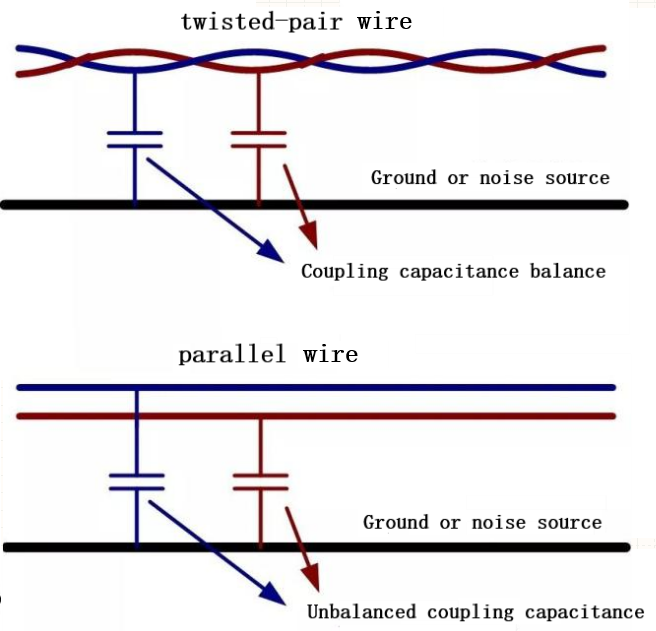
Compared to parallel wires, the coupling capacitance values of each wire in a twisted-pair cable to the interference source or ground are closer, resulting in a more balanced impedance, as shown in Figure 1.
Figure 1
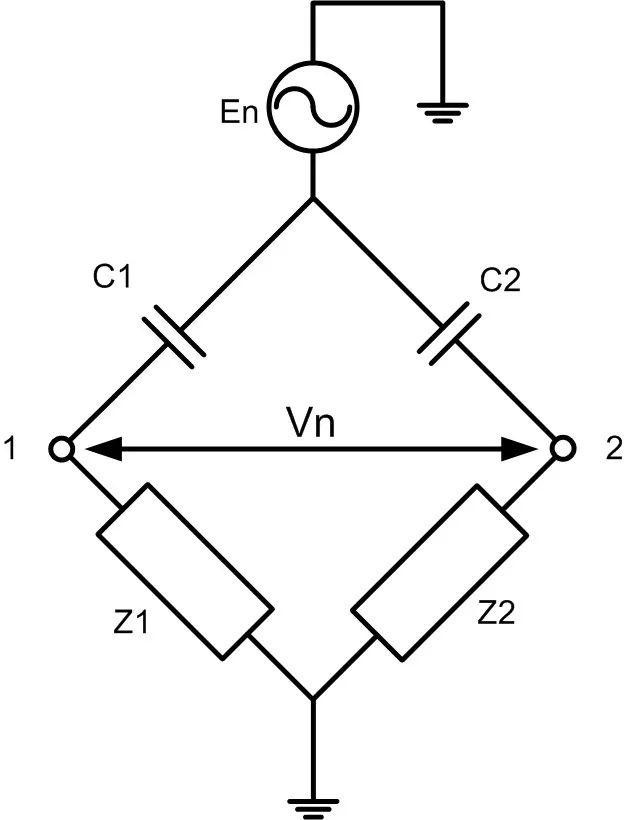
Because the twisted pair wires are tightly wound together, the coupling capacitance between the two wires and the noise source, and the impedance to ground are essentially the same. The interference current flowing from the noise source into the two signal lines is basically identical, and the difference between the two signal lines remains unchanged. The current from the coupling capacitance is converted into common-mode interference. As shown in Figure 2, C1=C2 and Z1=Z2, so the current flowing into C1 and C2 from the interference source is equal, meaning the voltages generated on lines 1 and 2 are equal, and Vn=0. Because the differential signal transmission method has excellent common-mode rejection capability, the effects of capacitive coupling can be eliminated.
Figure 2
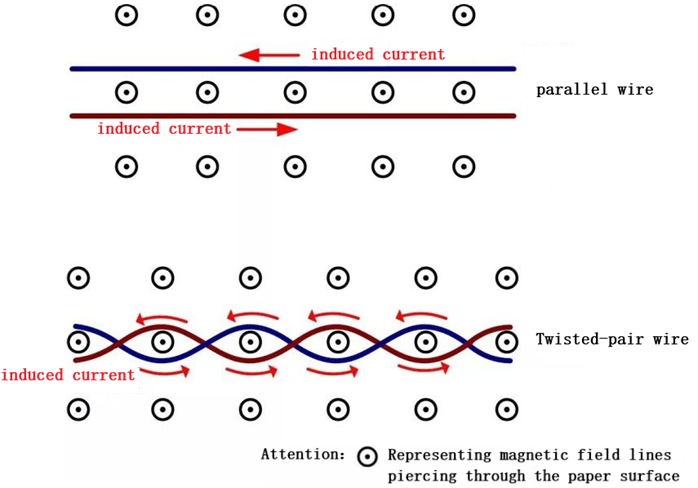
If parallel lines are used, the two signal lines will form a very narrow loop, which will pick up magnetic field interference from the environment. The structure of a twisted-pair cable involves twisting the two conductors of the transmission line at a fixed interval, causing the direction of the electromotive force induced by the magnetic field to reverse at each adjacent "small loop," thus sequentially canceling it out. From a circuit perspective, the mutual inductance at each adjacent "small loop" is opposite to the noise source, and the overall mutual inductance of the conductors becomes zero. As shown in Figure 3, when parallel lines are subjected to external magnetic field interference, the induced currents in the two conductors cannot cancel each other out, resulting in a large induced voltage that affects signal transmission. The structure of a twisted-pair cable, however, causes the induced currents in the conductors to cancel each other out, preventing the generation of an induced voltage.

In differential transmission applications, twisted-pair cables can eliminate capacitive and inductive coupling with external interference sources. Therefore, twisted-pair cables are widely used in differential signal transmission applications such as CAN and RS-485.