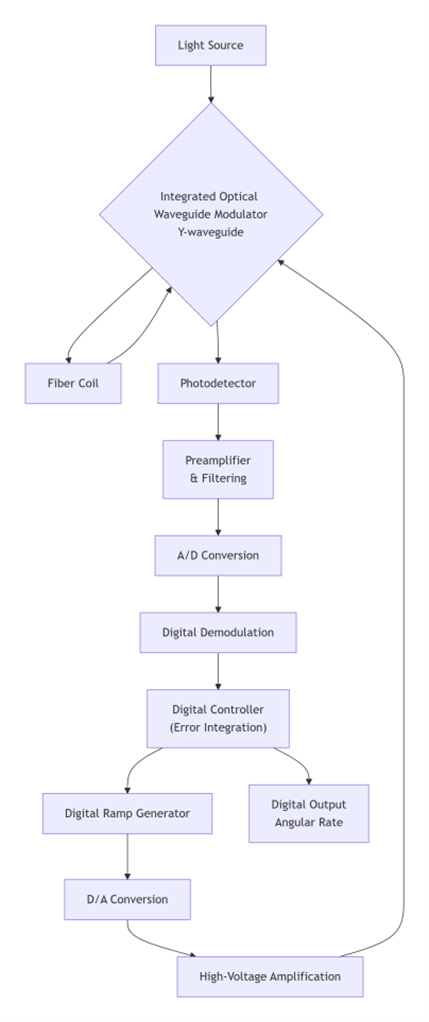
The fully digital closed-loop modulation and demodulation scheme is currently the mainstream technology for high-precision interferometric fiber optic gyroscopes (IFOGs). It modulates and demodulates optical signals under closed-loop conditions through digital circuits, thereby extracting rotational angular velocity with high linearity.
A typical fully digital closed-loop signal processing system diagram is shown in the figure below, with key technologies and optimizations including system bandwidth improvement, modulation distortion suppression, and hardware platform implementation.

Improvement of System Bandwidth
By adopting a triple frequency modulation/demodulation scheme, the sampling period is shortened to one-third of the fundamental frequency scheme, significantly increasing the system bandwidth and better compensating for high-frequency noise signals, improving dynamic performance without affecting static accuracy.
Suppression of Modulation Distortion
This method adopts a bipolar zeroing pulse square wave demodulation method, which can effectively eliminate or suppress the influence of modulation distortion. Compared to conventional demodulation methods, this technique can reduce the relative error of measuring angular velocity by an order of magnitude (from 1% to 0.1%), which is of great significance for improving the measurement accuracy and stability of closed-loop gyroscopes.
Implementation of Hardware Platform
All-digital closed-loop schemes typically rely on high-performance digital signal processing platforms. Due to its strong parallel processing capability, high integration, and good flexibility, FPGA has gradually become the mainstream choice. FPGAs can perform all digital demodulation, timing logic control, digital filtering, and even some preprocessing functions.
The all-digital closed-loop modulation and demodulation scheme achieves linear extraction of FOG signals through the synergistic operation of phase modulation biasing, digital correlation demodulation, and stepped-wave phase feedback. This scheme is not only key to achieving high precision and a large dynamic range in FOG, but also its adaptability in high-dynamic environments and its level of integration are constantly being improved.